
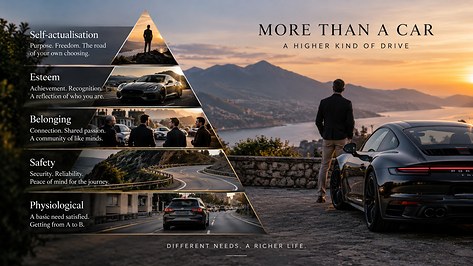
📍 ‘Maslow, Luxury — and Why We Buy the Car We Don’t Need.’
A Rolls-Royce, Ferrari or Bentley performs broadly the same fundamental task as a perfectly respectable family saloon.
It moves people.
Which rather begs the question: why does anyone spend £300,000 doing something that £30,000 can accomplish?
Abraham Maslow may have supplied part of the answer — in 1943.
♔ Full Story
▪️ Psychologist Abraham Maslow proposed that human motivation progresses through needs: physiological survival, safety, belonging, esteem and, ultimately, self-actualisation.
▪️ Applying that thinking to cars and the bottom of the pyramid is straightforward. Transport satisfies a practical requirement:
I need to get there.
▪️ Move upwards, and things become more interesting.
A Mercedes-Benz or Range Rover might communicate achievement and status.
Ferrari, Bentley, and Rolls-Royce take it further: craftsmanship, exclusivity, and identity become as important as transportation.
▪️ At the very top, however, luxury can become surprisingly personal.
The collector buying the car he dreamed about at age twelve may care very little whether anybody else notices.
A bespoke Rolls-Royce, carefully specified Porsche or long-sought Ferrari can become an expression of taste rather than wealth.
▪️ That is where prestige becomes something more interesting than conspicuous consumption.
♔ Bottom line:
Perhaps the greatest luxury isn’t owning something because other people recognise its value.
▪️ It’s reaching the point where you choose it simply because you do.
Maslow would probably have understood.
📍 ‘Although he never had to configure a 911.’
