
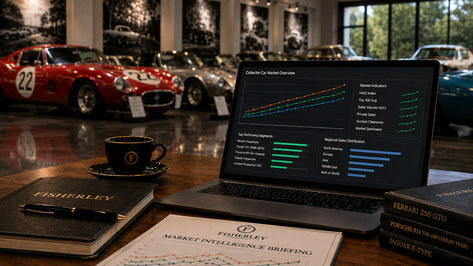
📊 ‘The collector-car market is not booming everywhere. It is becoming more discriminating.’
Monterey produced extraordinary headline figures, yet broader values remain softer. Buyers are still spending heavily.
But increasingly on the exceptional, the beautifully documented and the impossible to replace.
Mediocrity, meanwhile, is discovering gravity.
Full story
♔ Market signal: Confidence has returned at the summit, but it has not filtered evenly through the foothills.
▪️Record theatre: Monterey’s 2026 auctions generated approximately $755 million—roughly double previous levels.
A Shelby Cobra Daytona Coupe reached $42.9 million, while a McLaren F1 achieved $34.7 million.
Seven of the ten highest sales were Ferraris.
▪️The important distinction: These results do not indicate that every collector car has suddenly become financial catnip.
Hagerty’s broader data still shows a softening mainstream market, while the very best machinery remains resilient.
▪️Modern classics mature: Salon Privé awarded its inaugural Concours d’Excellence title to a 1995 McLaren F1, alongside a 1969 Lamborghini Miura taking traditional Best of Show honours.
The message is clear: blue-chip collecting no longer stops at chrome bumpers.
▪️What buyers want: Rarity alone is insufficient.
Originality, recognised provenance, correct specification and meticulous documentation increasingly determine whether bidding becomes animated—or merely polite.
▪️What to watch: The next European sales will test whether Monterey’s confidence travels, particularly across Ferrari, air-cooled Porsche and limited-production analogue supercars.
♔ The bottom line: The market is neither collapsing nor universally soaring.
It is separating.
Exceptional cars are being treated as global assets.
📍 ‘Average examples are being treated as cars—which, for some vendors, may come as an expensive surprise.’
