
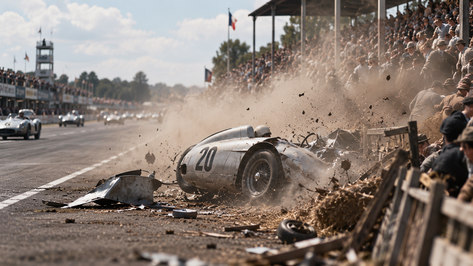
🏁 On 11 June 1955, the world’s greatest endurance race became the scene of motorsport’s worst catastrophe.
A Mercedes-Benz 300 SLR hurtled into spectators, killing 83 people and its driver.
The race continued. The consequences would change motorsport forever.
♔ Full Story
▪️When Speed Outran Safety
▪️Le Mans, June 1955. Jaguar, Mercedes-Benz and Ferrari had assembled their finest machinery. Fangio, Moss and Hawthorn were among the stars.
▪️Speed was everything; safety, rather less so.
▪️Then, shortly after 6.20 pm, catastrophe.
▪️The manoeuvre: Mike Hawthorn braked sharply in his Jaguar D-Type to enter the pits. Lance Macklin swerved his Austin-Healey to avoid him.
▪️The collision: Pierre Levegh’s Mercedes-Benz 300 SLR struck Macklin’s car and launched into the air.
▪️The tragedy: The Mercedes disintegrated, hurling heavy components into packed spectator areas. Levegh and 83 spectators died. Many more were injured.
▪️The astonishing decision: Racing continued, reportedly to prevent departing crowds from obstructing emergency services.
▪️Mercedes withdrew its remaining cars overnight. Jaguar continued, with Hawthorn and Ivor Bueb taking victory the following afternoon.
▪️The celebrations were understandably controversial.
▪️The repercussions were profound.
▪️Several countries suspended racing, circuits faced scrutiny, and Mercedes withdrew from motorsport at season’s end.
♔ The bottom line: Le Mans 1955 exposed an uncomfortable truth. Engineering brilliance had comprehensively outpaced the protection of those watching it.
📍 ‘The sport survived. Its innocence did not.’
