
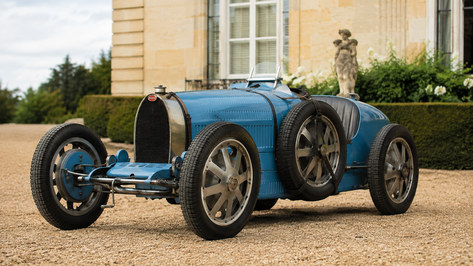
🚩 Some racing cars look fast. The Bugatti Type 35 looked as though it had been drawn by somebody who considered ugliness a personal failing.
Yet beneath that extraordinary elegance sat one of the most formidable competition cars ever created.
A century later, the Type 35 remains the rare thing that modern performance cars spend millions trying to become:
Beautiful, technically clever and completely authentic.
Full Story
♔ Why it matters: The Bugatti Type 35 didn’t merely win races. It established the idea that engineering and beauty didn’t have to live in separate buildings.
▪️Introduced in 1924, Ettore Bugatti’s Type 35 was conceived as a competition car rather than a road-going machine subsequently persuaded to go racing.
▪️Its engineering was wonderfully obsessive: lightweight construction, a hollow front axle and those famous cast-aluminium wheels incorporating the brake drums.
▪️The first outing, at the 1924 French Grand Prix near Lyon, wasn’t particularly glorious. But what followed certainly was.
▪️Bugatti credits the Type 35, and its derivatives, with around 2,500 victories and podium finishes during its active period. At its peak, the Type 35 averaged 12 race victories a month.
▪️It won the Targa Florio five consecutive times between 1925 and 1929 and secured the 1926 Grand Prix World Championship.
♔ The clever bit: This wasn’t simply a brutally effective racing machine. It was beautiful enough to become an object of desire in its own right.
▪️Imagine today’s Formula One engineers being told that lap time was important, but the car should also look magnificent parked outside the Hôtel de Paris.
♔ Bottom line: The Type 35 never really pretended to be a racing car.
It pretended to be civilised.
📍 ‘That was the clever part.’
