
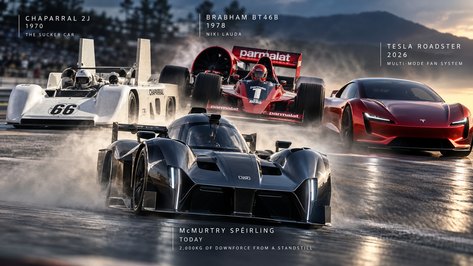
 Most supercars need speed to generate downforce. The McMurtry Spéirling switches on a pair of fans.
But this particular piece of engineering mischief is hardly new.
Chaparral tried it in 1970. Brabham caused a Formula One scandal in 1978. And Tesla has promised its own interpretation.
The difference?
Conventional supercars need airflow. Fan cars bring their own vacuum cleaner.
Suddenly, the laws of aerodynamics become much more entertaining.
♔ Full Story:
Downforce Without the Drama
 1970 — Chaparral 2J. Nicknamed The Sucker Car, Jim Hall’s extraordinary Can-Am machine used two auxiliary fans and sliding skirts to create suction beneath the chassis.
It was spectacularly quick, mechanically troublesome and subsequently outlawed.
1978 — Brabham BT46B. Gordon Murray’s infamous fan car, driven to victory by Niki Lauda at the Swedish Grand Prix, ostensibly used its enormous rear fan for cooling.The resulting suction was rather useful. One race, one victory, then voluntary withdrawal amid political controversy.
Today — McMurtry Spéirling. Two electric fans generate approximately 2,000kg of downforce from a standstill.Unlike a Ferrari or McLaren, which rely primarily on speed-dependent aerodynamics, McMurtry delivers extraordinary grip before the wheels have gathered momentum.
Tomorrow — Tesla Roadster.Elon Musk has teased unconventional thrust technology, although a production-ready multi-mode fan-downforce system remains unconfirmed.
♔ Why it matters:
Conventional supercars grow their aerodynamic grip with speed. Fan cars can generate substantial downforce while stationary.
The McMurtry hasn’t invented the principle.
 ‘It has simply made a fifty-year-old idea look embarrassingly modern.’
