
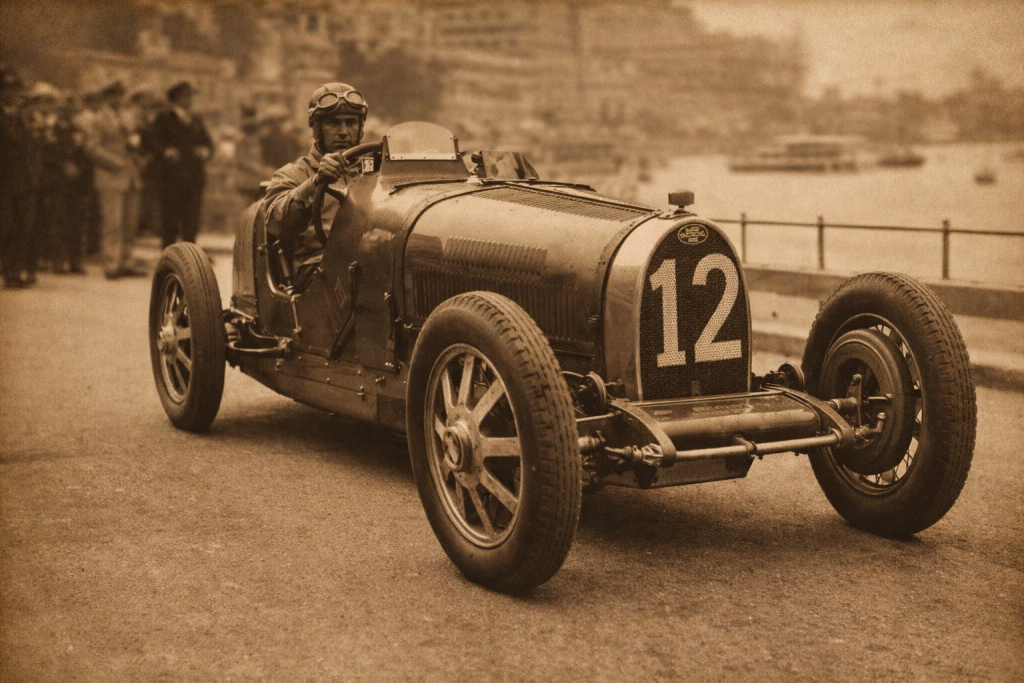
📍 ‘Monaco, today, is champagne, yachts, and qualifying laps measured in atoms.’
But in 1929, it was something far more entertaining: a gamble.
A tight ribbon of public road, lined with lampposts, stone walls, and optimism. No run-offs. No safety cars. Just bravery… and Bugatti’s.
And then, quite wonderfully, an unknown Englishman turned up — and ruined everyone’s afternoon.
Because the first Monaco Grand Prix wasn’t won by a legend.
It created one.
Full Story
♔ The backdrop:
◼︎ 1929: Monaco seeks spectacle, not subtlety
◼︎ Conceived by Antony Noghès to bring racing into the streets of Monte Carlo
◼︎A circuit defined by harbour edges, elevation, and zero margin for error
♔ The grid:
◼︎ Dominated by factory-backed favourites.
◼︎ Heavy expectation on established continental drivers
◼︎ Bugatti Type 35 machinery forms the backbone of the field.
♔ The upset:
◼︎ Victory goes to an ‘unknown Englishman’ — William Grover-Williams.
◼︎ Driving a privately entered green Bugatti Type 35B
◼︎ Defeats the heavily favoured Philippe Étancelin and others
♔ The theatre:
◼︎ Crowds lining balconies and pavements, inches from the action
◼︎ No barriers, no forgiveness — only precision and nerve
◼︎ Monaco instantly proves itself as the sport’s most glamorous risk.
♔ Why it mattered:
◼︎ Established Monaco as the crown jewel of Grand Prix racing
◼︎ Proved that brilliance could emerge from obscurity
◼︎ Cemented Bugatti’s dominance in early circuit racing
♔ The legacy:
◼︎ From that first upset, the most prestigious race in motorsport grew.
◼︎ Still tight, still unforgiving — just with better tailoring
♔ Bottom line:
Monaco didn’t begin as a procession of privilege.
It began as a street fight.
📍 ‘And, rather fittingly, it was won by a man nobody saw coming.’
