
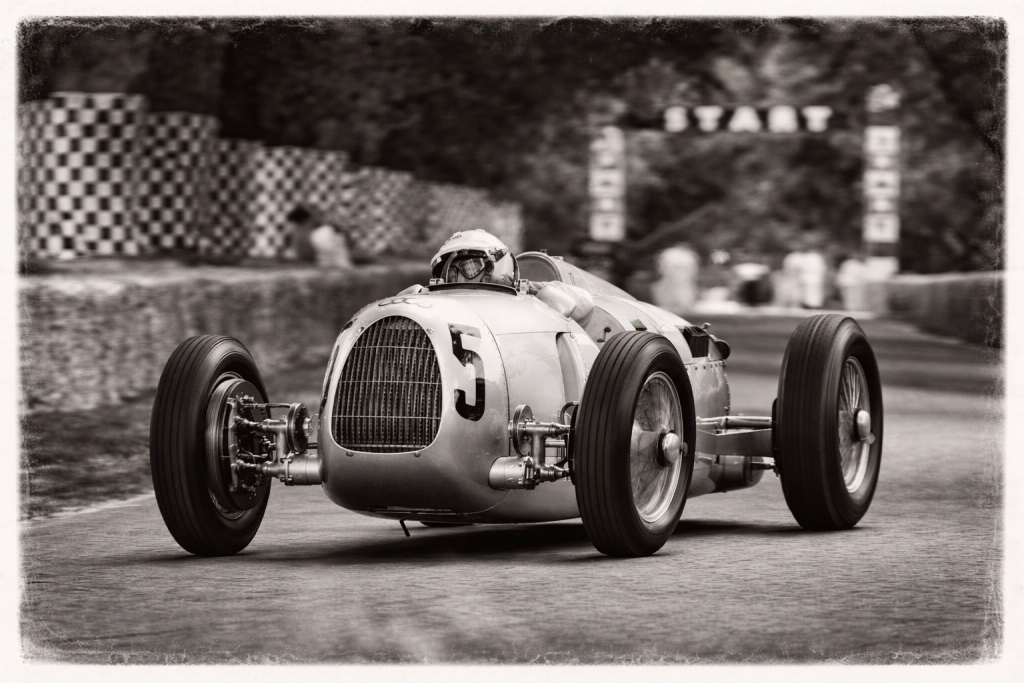
 ‘The Auto Union V16 reminds us that true innovation is rarely comfortable, and never polite.’
270mph in 1938 wasn’t bravado — it was belief.’
◼︎ Sixteen cylinders, a mid-engine layout decades ahead of its time, and drivers brave enough to race with a wet handkerchief clenched between their teeth.
◼︎ The Auto Union V16 didn’t just challenge physics; it redefined what driving truly meant.
❖ The Full Story…..
270mph in 1938: The Auto Union V16 That Redefined Driving
Since pioneer days, driving has meant controlling power and direction — not merely hanging on.
◼︎ By the early 1930s, engines had replaced hooves, and engineers like Ferdinand Porsche were using machinery as a canvas for daring ideas.
◼︎ Grand Prix racing was transformed in 1933 when organisers replaced heavyweight monsters with a strict 750kg maximum. Sensing national prestige.
◼︎ Adolf Hitler backed Germany’s Silver Arrows.
◼︎ Mercedes-Benz expected supremacy. Instead, the newly formed Auto Union — Audi, DKW, Horch and Wanderer — arrived with something unsettling: a Porsche-designed, mid-engined car.
◼︎ Its heart was racing, first V16. Porsche, aided by Karl Rabe and aircraft specialist Josef Kales, pursued torque over revs — doubling cylinders to exploit displacement within the weight limit.
◼︎ Aluminium construction, integrated drivetrain and a novel single-cam, 32-valve layout made the car revolutionary.
◼︎ It was also brutal.
◼︎ Misfires spat raw fuel backwards, forcing Tazio Nuvolari — asthmatic and coughing blood — to race with a damp handkerchief in his mouth to survive the fumes.
◼︎ Then came January 1938. Streamliners on the autobahn.
◼︎ Caracciola set 269mph. Hours later, Bernd Rosemeyer pushed harder — perhaps beyond 270mph — before a crosswind claimed his life at just 28.
❖ Why it matters
Because real progress once demanded genius, nerve, and consequence — and the Auto Union V16 embodied all three.
‘If modern motorsport is chess, 1930s Grand Prix racing was fencing at 270mph.’