
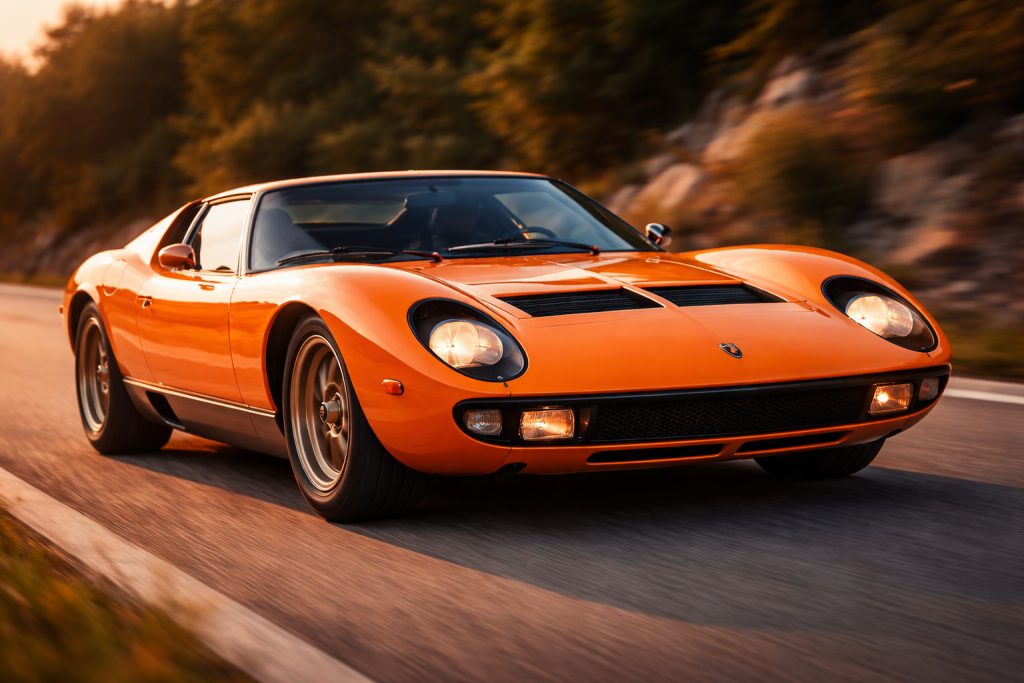
📍‘Sixty years young: 2026 marks the 60th anniversary of the Lamborghini Miura, the machine that essentially invented the modern supercar.’
◼︎ Revolutionary debut: First seen as a bare chassis at Turin in 1965, its mid-engine V12 stunned all before the body was even added.
◼︎ Supercar DNA: Debuted as the Miura P400 at the 1966 Geneva Motor Show, marrying breathtaking design and performance that rewrote automotive rules.
◼︎ Legacy in motion: Only ~764 built, yet its influence still fuels every mid-engine poster car in the world.
◼︎ Celebrations planned: Polo Storico tours and dedicated concours classes around the globe will honour six decades of genius.
♔ Sixty Years of Bull-Shaped Brilliance.
◼︎ In 1966, Lamborghini didn’t just launch a car; it defined a category.
The Lamborghini Miura’s 60th anniversary in 2026 isn’t mere cake and candles — it’s a salute to the moment when the blueprint for every modern supercar was etched in steel, leather and mid-mounted V12 brawn.
◼︎ The saga began in late 1965 at the Turin Motor Show with a satin-black chassis — no body, no frills — but a transversely mounted 3.9 litre V12 positioned ahead of the rear wheels.
It was audacious, raw and utterly unlike anything then on the road.
◼︎ By March 1966, at Geneva, clad in ink-black coachwork by Marcello Gandini at Bertone, the Miura P400 stunned the world.
Lamborghini had pulled off what others dismissed as impossible: a mid-engine two-seater that was not only breathtakingly beautiful but blisteringly quick.
◼︎ Production numbers were modest — around 764 cars overall — yet those slender figures belied a cultural tidal wave.
Terminology itself shifted: automotive scribes whispered a new word, ‘supercar,’ to describe this sleek two-seater.
◼︎ In 2026, celebrations will be global and year-long, from dedicated classes at Cadillac concours like Moda Miami to a Polo Storico tour in Sant’Agata.
Paying homage to an icon that changed design, performance and the very idea of exotic cars.
📍 ‘Sixty years on, the Miura still looks modern, still turns heads, and still matters — which is more than many so-called classics can claim.’
